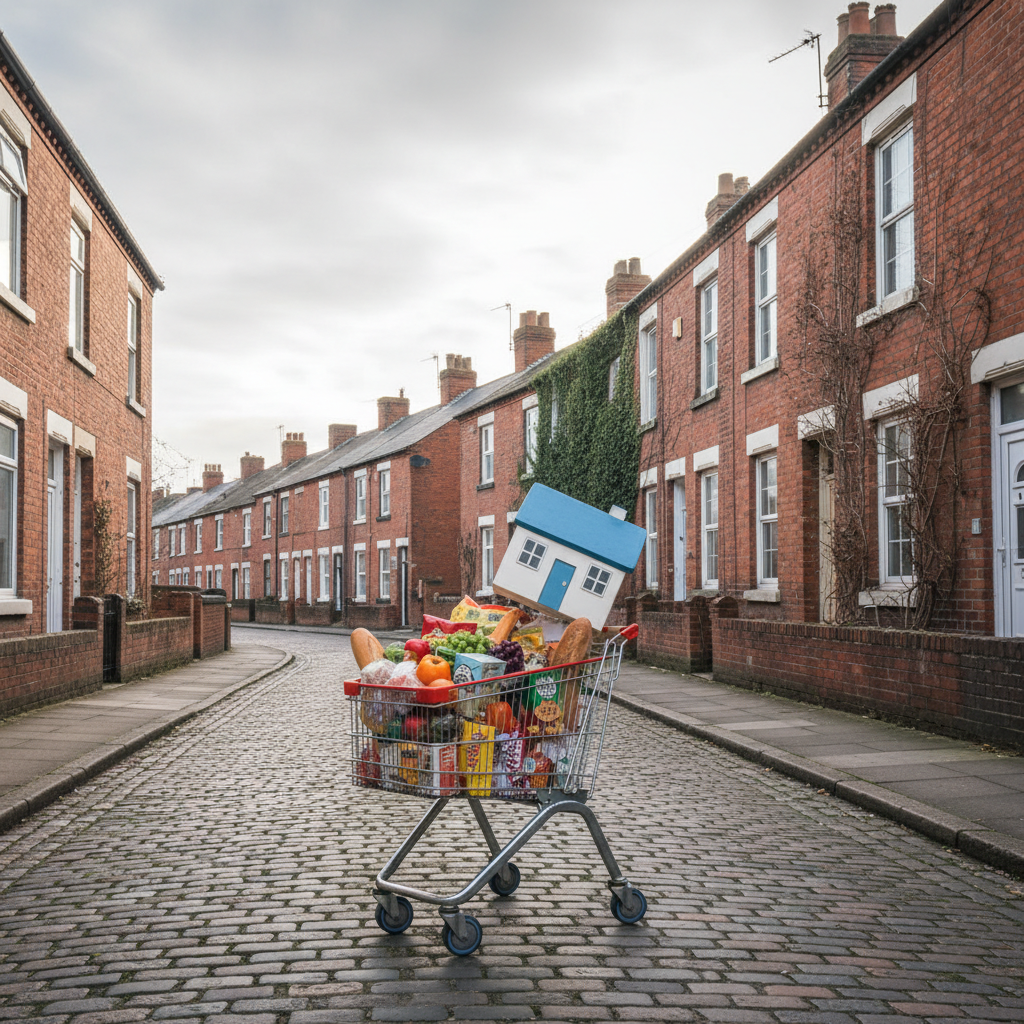
The Great Grocery Basket Race, May 2026 Inflation & Affordability Update
I was chatting with a neighbor earlier today while grabbing a coffee, and they said something I hear quite often lately: "Emanuele, I’m just going to wait until prices stop going up before I even think about moving. Everything is just getting too expensive."
It’s a common myth that when the "cost of living" goes up, the dream of moving house has to go on the back burner. But if we peel back the stickers and look at the real price tags, the reality in May 2026 is actually a bit more encouraging than you might think.
What’s happening with our pennies?
Think of "inflation" like a slow-motion race at the supermarket. Inflation is just the word for how much more expensive things—like a loaf of bread, a litre of petrol, or a new pair of shoes—become over a year. Right now, that rate is 3.4%.
Did you know that if you spent £100 on your shop this time last year, those exact same treats would cost you £103.40 today? It feels like a small nudge, but when it’s happening to everything you buy, it adds up. However, there is a silver lining. We’ve seen this number bounce around lately—it was as high as 3.6% back in February—so things are starting to feel a little steadier.
The pay packet puzzle
Here is the really interesting bit: while the price of your milk and eggs has gone up by 3.4%, the average person’s pay packet has actually grown by 3.6%.
Imagine you have two buckets. One bucket is the "Prices" bucket, and it’s getting fuller. The other is your "Wages" bucket. Because your wages are growing just a tiny bit faster than prices (by about 0.2%), your "Wages" bucket is actually winning the race! This is what we call a "positive signal." It means that for the first time in a while, your money is starting to stretch a little further rather than shrinking.
What does this mean for your move?
When your money has more "muscle," it’s easier to talk to a bank about borrowing for a home. The big bank in London that sets the rules (the Bank of England) has kept its main interest rate at 3.75%. This is the "fee" people pay to borrow money. Because this has stayed the same for a few months now, it’s giving people more confidence to make plans.
We are seeing about 62,600 people getting their home moves approved every month across the country. That’s a lot of families packing boxes! While the average price of a home nationally is about £284,720—which is actually a tiny bit lower than it was in March—the fact that wages are rising means that, bit by bit, a new home is becoming more "affordable."
Bringing it home to OL2 6
So, how does this national "tug-of-war" between wages and prices affect us here in OL2 6?
When people across the country feel they have a few extra pounds in their pocket, it ripples down to our streets. In OL2 6, the average price people are asking for their homes is £255,770. Because the local market is "balanced"—meaning there’s a fair mix of people looking to buy and people looking to sell—the fact that wages are finally beating inflation is great news. It means local buyers have more confidence, and for landlords, it often means tenants are in a better position to keep up with their monthly payments.
The world of money can feel like a bit of a maze, but the path is looking much clearer this May. With your earnings finally growing faster than the cost of your weekly shop, the "mountain" of moving house is starting to look a lot more like a hill.
Keep your chin up—things are moving in the right direction!